
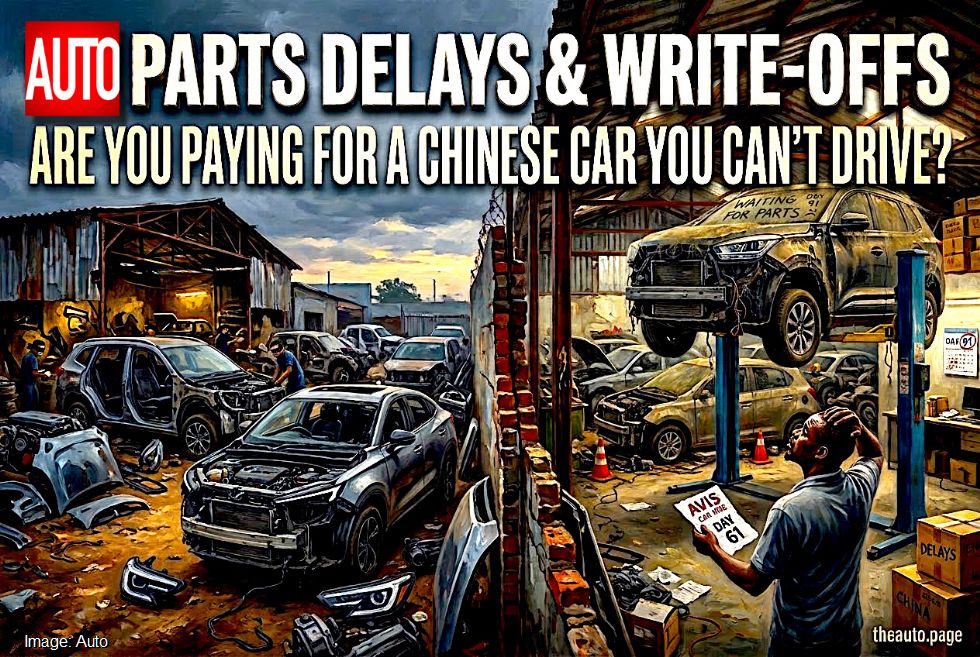
Auto China Report Part 4: How a little crash can leave you carless
Part 4 of the Auto China Report considers the parts debacle. When it comes to car parts, Chinese brands woo buyers by pointing out massive Gauteng warehouses full of spares. Chery and GWM claim 97% to 98% parts availability across 100 dealers each. Sure, it’s true for oil filters, brake pads, and wipers. Service parts for volume sellers are cheap and on the shelf. You will not wait for a 30,000 km oil change.
Just don't crash your Chinese car. While those service parts are easy to come by, the exact opposite applies to accident repair components. A smashed front end does not need an oil filter. It needs a matrix LED headlight, a millimetre-wave radar, a bumper harness, a radiator cradle, and a quarter panel. On newer Chinese sub-brands the likes of Jetour, Omoda, Jaecoo, BYD, GAC, Changan and JAC, local warehouses carry thin stocks of slow-moving body parts and coded electronics.
Worse still, Chinese brands facelift their models every 14 to 18 months, changing bumper moulds, grilles, and light clusters each time. SAMBRA-affiliated Mzansi panel shops report waiting three months or more on a good day for sea-freighted Chinese crash parts to clear Transnet ports. Even when a part is airfreighted, like when a six-week-old BYD Sealion 5 recently sat waiting for a month, dealers often wait weeks for factory coding access from China.
Service Parts Availability
Vehicle	Traditional SA	Traditional	Chinese       Chinese NEVs
Group	Manufactured	Imports 	Est. Imports  & New Imports
Brands	Toyota, VW,	Mazda, Citroen,	Chery, GWM,   Changan, BYD,
        Ford, Isuzu	Renault, Kia    Haval         Omoda

Service	1–2 Days	1–3 Days	1–4 Days      2–10 Days
Parts	Everywhere	Solid Stock	97% Stock     Stock Varies
The Rental Deficit and Your Own Back Sky
Short-term insurers and brokers have issued blunt warnings to buyers of newer imported brands: upgrade your car-hire cover immediately. Standard comprehensive policies give you 30 days of substitute car rental while your Chinese whip sits waiting for parts in the panel shop.
The catch is simple. Even if you pay extra to extend your policy, almost every retail insurer in South Africa caps car-hire extensions at 60 days maximum. When your crossover sits stripped for three months on a panel-shop lift waiting for a rear quarter panel and wiring loom from Wuhu, you must stump up for the rental car from Day 61.
So you’re on your own. Cough up the fifteen grand a month out of your own pocket to rent that budget hatchback while still paying the bank for your broken SUV. Or walk. Insurers also get hammered with panel-shop storage fees during those 90-day waits—a penalty they now price directly into monthly premiums on Chinese imports.
Crash Parts Availability & The Replacement Rentals
Vehicle	Traditional SA	Traditional	Chinese           Chinese NEVs
Group	Manufactured	Imports 	Est. Imports      & New Imports
Brands	Toyota, VW,	Mazda, Citroen,	Chery, GWM,       Changan, BYD,
        Ford, Isuzu	Renault, Kia    Haval             Omoda

Car Rental   30 Days      30–60 Days	  60+ Days	  60–90+ Days
Requirement  Standard     Possible Top-Up Top-Up Required Uninsured 60+
The Ranger Paradox & Out-of-Warranty Cash-Ins
Look, the legacy brands are shameless too. Ford builds 720 Rangers and Amaroks a day at its Silverton, Pretoria plant. Yet local owners still complain of waiting weeks for Bi-Turbo actuators, 10-speed gearbox valve bodies, and matrix headlights. Why? Because Silverton prioritises export contracts to 180 global markets on a strict Just-In-Time line. Stopping an export line costs millions; leaving a local customer's bakkie at a panel shop costs Ford nothing.
Yet the Ranger, and locally built Toyotas, Volkswagens, and Isuzus, have three safety nets that Chinese cars lack. First, high-impact steel panels, load bins, and PG Glass windscreens are stamped right here in SA. Second, every independent RMI workshop in the Platteland has the diagnostic tools to code a Ford or Toyota. Third, massive fleet volumes feed a huge scrapyard and pirate-parts ecosystem.
That aftermarket gap is now an industry goldmine. In its August 2026 results, CMH noted that as the 2021–2022 wave of Chinese cars exits its 5-year factory warranties, owners refuse to pay steep franchise dealer prices or wait months for parts. Instead, CMH's aftermarket supplier, Motor Parts Direct, cashes in on generic mechanical parts to keep out-of-warranty Chinese imports running.
Specialised Parts & Salvage Stocks
Vehicle	 Traditional SA	Traditional	Chinese        Chinese NEVs
Group	 Manufactured	Imports 	Est. Imports   & New Imports
Brands	 Toyota, VW,	Mazda, Citroen,	Chery, GWM,    Changan, BYD,
         Ford, Isuzu	Renault, Kia    Haval          Omoda

ECUs &	 5–21 Days	14–45 Days	21–60 Days     45–120 Days
Radars	 Export Bias	Airfreight	High Cost      Coding, Shortages

Salvage	 Massive Yards 	New: High	Growing        Zero
/Pirate  & Aftermarket	3Y+: Strong	3–5Y Stock     OEM Only
The Write-Off Cliff and The Chinese Car Theft Spree
When tumbling resale values meet lofty crash-parts prices, the insurance write-off calamity is never far behind. Take an average three-year-old R250K trade-in book value Chinese SUV, for instance. Insurers typically write a car off as uneconomical to repair when crash damage breaches two-thirds of its trade value, which in this case amounts to just R162K.
Because Chinese OEMs demand R35K for an LED headlamp, R25K for a bumper radar module, R30K for a grille assembly, and R45K for airbags, a minor fender-bender repair all of a sudden tops R170K. So faced with that bill, let alone a three-month wait for parts and a fight with the insured over the hire car in a few weeks’ time, insurers simply write the car off as salvage. And if you failed to tick the Credit Shortfall box on your finance contract, you owe the bank the difference.
The crash-parts drought also busts the myth that criminals ignore Chinese cars. Fidelity ADT and the Insurance Crime Bureau confirm that Haval, Chery, and other popular Chinese models are rapidly becoming car theft targets. Syndicates steal them to strip scarce crash parts and fragile gearbox replacements for black-market cash. And because Chinese SUVs’ proximity keyless entry systems lack European motion-sensing fobs, thieves use cheap signal-relay boxes to steal them in 20 seconds flat.
Car Theft & The Need For Chinese Car Parts
Vehicle	Traditional SA	Traditional	Chinese	Chinese NEVs
Group	Manufactured	Imports 	Est. Imports   & New Imports
Brands	Toyota, VW,	Mazda, Citroen,	Chery, GWM,    Changan, BYD,
        Ford, Isuzu	Renault, Kia    Haval          Omoda

Theft	Extreme: Hilux,	Low to	High   ‘Next Wave’     Moderate. High
Risk	Ranger, Polo	Moderate	Spares Target  Keyless Risk
Real Local Manufacture or Screwdriver SKD?
Chinese carmakers know that importing fully built cars makes them political targets. So Chery bought Nissan's 60-year-old Rosslyn plant in Pretoria earlier in the year and targets 50,000 Tiggo 4s and Jetours per annum from the middle of next year. Now we hear that GWM is negotiating to co-manufacture vehicles with Mercedes-Benz at its East London plant.
Not so fast. For years, BAIC’s Coega plant in Gqeberha exploited the Semi-Knocked Down loophole as it shipped in pre-painted, partially built car kits from China and bolted the wheels and sub-assemblies on locally, just to dodge the 25% import duty. So in October 2026, Trade and Industry Minister Parks Tau finally dropped the axe on ‘screwdriver’ assembly. Government is phasing out all existing SKD subsidies and curbing SKD plants as it tightens Complete Knocked Down rules to enforce genuine ground-up local manufacturing.
That simply leaves Chery and GWM with nowhere to hide. They can no longer simply bolt imported car kits together in Pretoria or East London and call them South African. Under the new rules, they must either invest billions to stamp local steel, fit PG Glass, and contract Mzansi Tier-1 component suppliers. Or pay full import duty. Until they actually stamp body panels on South African soil, all that buying a factory gets the Chinese are propaganda headlines vomited out by copy-and-paste mobility ‘scribes’. And your smashed Chinese SUV sits tall on a panel-shop lift for three months waiting for that ship from Shanghai.
Auto China Car Report 2026 Navigation