Auto China Report Part 1: Why Chinese cars feel like cardboard
Chinese cars punch hard in the showroom. Doors shut with a thunk. Double-glazed glass kills the noise and their spec sheets read like a German luxury sedan. At half the price. They ace five-star NCAP crash tests too, and if you spend your life crawling the N1 at 40 km/h listening to a podcast in the hush of a plush cabin, then hey, presto!
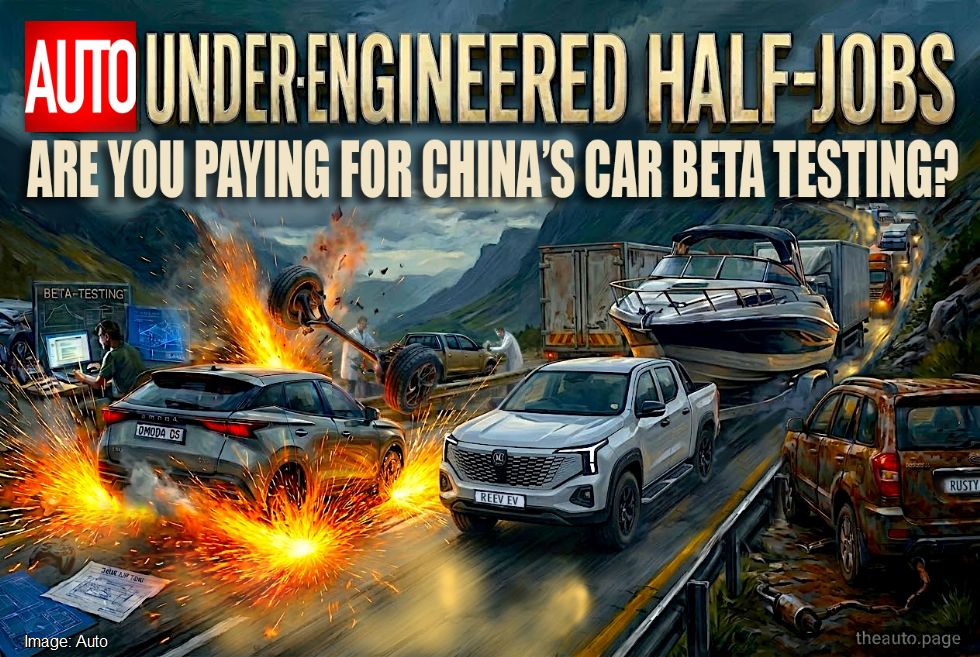
Under the skin, however, Chinese cars swap 60-month Kalahari torture and Swedish ice tests for an arbitrary games-console simulation. Which leads to poorly engineered and direly developed cars that bleed half-baked refinement devoid of even the scent of sophistication. A traditional carmaker spends two full years of its five-year development cycle with chassis engineers living out of suitcases to break prototypes on corrugated hell dirt, hone damper valves, tweak brake progression and find that gearbox map sweet spot.
Not in China, however. They’d rather brag about ‘China Speed’ and how fast they can belch a car out from CAD to street. They rummage highly amortised generations-old brand-name parts off the shelf, from Bosch stability modules to Getrag dual-clutch gearboxes and BorgWarner differentials. Cobble all that to billion-off sweat shop generic engines, marry it with God knows who wrote it electronics and shove it all through a computer simulation as quick as you can run through your shower. And hey Presto! There’s the next generation Chinese car on the ship to Africa. But guess who’s the clown paying for the beta-testing? That will be you, buddy. The Chinese car owner. So while legacy brands drop billions on test and development, it’s just wham, bam, hello ma'am down China way.
Structural Faults
Chinese Brands  	Legacy Brands   	Verdict
Omoda 5 Rear Axles	Full E-Coat Rust 	Far Superior Legacy
Snapped Off, 60K	Baths, 12Y Corrosion 	Brands Offer Peace of
Recalls In Malaysia,	Cover, Few Structural 	Mind While Chinese
SA Coastal Subframe	Concerns Beyond Rare 	Concerns Linger
Rust In 18 Months	Bracket Recalls
Cheap as Chips, Rapid Rust and the Snap-Off Axle
So now you wonder why they’re cheap as chips. Well, that’s because Chinese cars are just as good as cheap, sloppy chips. Chinese cars fail versus their traditional peers on every basic chassis engineering front, from rust protection to payload maths, and road manners to plain old engineering. For example, an Omoda C5’s complete rear axle recently snapped off the back of the car on a mundane freeway run. Chery recalled a few hundred cars, blamed an uncalibrated robotic welding tip on a four-day batch and swore that all South African cars were safe.
Then it happened again in Malaysia. This time, the Malaysian Road Transport authorities banned Omoda 5 registrations altogether, ordered a factory audit, and forced a recall of 8,878 vehicles (Stop Press! that was elevated to over 50,000 as we prepared to publish) while other export markets ran quiet ‘precautionary checks.’ Rear axles breaking off cars twice in a couple of months is not just bad luck. It’s gross negligence on the part of the carmaker, and clear evidence of rushed, profit frenzied development that ended up with a supplier quality failure as a direct result of rushing cheap, untested and unqualified cars into mass production.
Then some people took a look underneath a few average Chinese cars after a couple of sweaty Durban summers. Coastal South African panel shops and fleet teardowns are reporting pandemic levels of rusted Chinese subframes, exhaust hangers, and suspension brackets within months of the cars rolling off those glitzy showroom floors. To save a buck per body shell in China, factories use partial dip-galvanising and skip heavy PVC underbody seam-sealing. Locally built Toyotas, Volkswagens, and Fords go through full E-coat anti-corrosion baths built for coastal humidity. And they back it up with 12-year rust warranties. Good luck with your Chery, my cherry!
GVM & Legal Payload
Chinese Brands          Legacy Brands           Verdict
Jaecoo J7 335 kg, 	550-1050kg  Payload,	Legacy Far Superior.
Jetour T2 375 kg    	Uprated Brakes Across   Marginal Chinese False
Overloaded Without      All Rival SUVs &        'Adventure' SUV Advertising
Luggage                 Bakkies

Engine & Gearbox
Chinese Brands          Legacy Brands      	Verdict
Jerky 7DCTs, 30 in     	Ford & Peugeot Wet 	Different Sins:
100 faults Y 2-3,	Belts, Ford 10AT 	Legacy Design Issues
Jaecoo J7 Recall,	Glitches, Early VW 	Chinese Drive Worse
10-13 l/100 Thirst	Dry DSG, Toyota DPF
The Jaecoo GVM Farce and the Rugby Front Row Fiasco
Then just as Malaysian highway officials finished mopping up those spat axles, came the next China car fiasco, right here in good old braaivleis, rugby, sunshine and… no, not Chery… South Africa. While the Chinese pack heavy panoramic glass roofs, electric tailgate motors, thick glass, and 20-inch wheels onto standard-duty crossovers, it seems someone, somewhere forgot to do some very basic sums. The Jaecoo J7 and Jetour T2 Gross Vehicle Mass farce is nothing short of a joke. And by their own sales figures, literally have tens of thousands of South Africans driving their Chinese cars illegally.
Because engineers back in the Mainland failed to, or is that forgot to uprate the brakes, wheel bearings, and suspension bushes to match those cars’ stratospheric new gizmo-rich unladen kerb weights, they left no room for… wait for it, the tank of fuel, luggage or even a fourth burly occupant within the cars’ legal load weight limits. Check the Jaecoo J7 1.6T spec sheet. Subtract that 1,658 kg kerb mass from its legal 1,939 kg GVM and what do you get? Yip, 281 to 335 kg depending on the model. Same for the Jetour T2 – which is apparently a rugged adventure 4x4 rival.
How the hell can they call that a Fortuner or Defender rival when it can’t even carry 350 kg? And that 350 kilos includes about 50 kg of fuel. But how does that affect you, the owner? Well, do the maths. Put three average South African rugby forwards, or four average 95 kilo blokes into a J7 or T2 without fuel, cooler boxes, or luggage, and the car is already illegally overloaded. Have a crash down Van Reenen's or on Bryanston Drive at more than your plated GVM, and your insurer will walk away. A Fortuner, an Everest, or a RAV4 carries a legal payload of between 550 and 700 kilos. Just saying.
Throttle & Brakes
Chinese         	Traditional     	Verdict
Abject Launch Failure	Linear Throttle 	Legacy Far Superior.
Then Violent Wheelspin,	Progressive Brakes	Untested Chinese Have
Hair Trigger Brakes,	Torque-Based    	No Feel Between Right
Clunky Auto-Hold	Gearbox Logic.  	Foot & Road.

Steering & Chassis
Chinese         	Traditional     	Verdict
Lifeless ‘Cardboard’	Natural Self-Centring	Dynamic Legacy Cars
Steering, Cars Waft,	& Supple Euro/Jap Ride,	Far Superior. Chinese
Wobble & Wallow, Brake	Sophisticated Damping	Lack Development,
Rotors Warp     	& Taut Body Control	Finesse, Sophistication.
Launch Failure, Russian Roulette Brakes & Cardboard Steering
Drive them hard, and Chinese vehicles just feel crap. All of them. To a car. Step from driving any three Chinese SUVs on the trot and into a base Volkswagen, Renault, or Toyota, and the legacy chassis seem dreamy in comparison. A proper BMW or Merc feel as if they’ve landed from another, way more advanced and more superior planet. Auto Tests highlight this phenomenon every week. And for very good reason too.
Spot a gap, squeeze the pedal and pull away into the traffic circle. In way too many Chinese cars, nothing happens for two agonising seconds while the gearbox software panics trying to communicate with its clutches and that sweatshop lump struggles to suck the thin Highveld air in. Push deeper and all of a sudden, the clutches bite, the turbo spools right up and all at once, all hell breaks loose. The front end lights up in violent wheelspin. Until traction control finally shuts it right back down. All or nothing and not very much in between. It also happens in some legacy models. But abject launch failure is a far more viral disease in Chinese cars.
Touch the brakes, and the pedal swings from dead wooden to binding midway through the stroke. And be careful that the pedal doesn’t just snap off. Or the steering column for that matter. It’s more than just Chinese axles that break off. Speaking of Chinese axles, electric steering feel is cardboard across the board. Zero road feel, zero feedback, and simply no semblance of weight. Chinese cars also waft, wobble, and wallow along. Soft springs, under-damped shocks and who knows where the hell that suspension geometry comes from. Can’t be the Nürburgring, we doubt any of these cars know where that is. Or what it means. Who cares anyway, when gullible car buyers buy on price alone. Well on the face of price, anyway.
Touring, Towing & Spares
Chinese         	 Traditional     	   Verdict
Shark 6 2500kg, SUVs	 Contemporary 3500 kg	   Legacy Far Superior.
750-1500 kg Towing,	 Max Towing; Steady        Soft Chinese Hardly
Dead-PHEV Power,         Diesel Range; Full-Size.  Adequate to Climb
Thirst, Biscuit Spare,   SpareWheels & Standard    a Kerb. Legacy Bakkies
Odd 20-in Tyres 	 Brand Tyres, Sizes	   Fully Tow, Trail Ready.
The Plug In Lie, Substandard Towing & Biscuit Spares
Another Chinese brand favourite are plug-in hybrids and range-extender EVs. Their makers like to think they’re flooding the market with the likes of the BYD Shark 6, Changan Hunter REEV, Jaecoo J7 SHS, and the Chery Tiggo PHEVs. They claim up to 320 kW, 1.8 litres per 100 km economy, and a 1,200 km driving range on China's laughable CLTC test cycle. All wonderful smoke and mirrors.
But tow your speed boat, horse box or race car along the N1 towards Gauteng and suddenly the Karoo wind blows that lively PHEV smoke away. And those mirrors lie smashed on the Karoo rock like the cheap Chinese promises they always were. The battery will be dead by the time you reach Worcester. So you’re left dodging pantechnicons with a wheezing 1.5-litre four-pot screaming blue murder in its futile attempt to haul that dead weight up the hill at a snail’s pace while it desperately tries to charge the battery too. Fuel consumption explodes to 15 per hundred. You’d do better trying to overtake a bunny than the fully laden truck pulling away up the incline.
Were you pulling in a good old Hilux, Ranger, or D-Max, first you’d tow a tonne more than your disgraced BYD or Changan. Second you’d hardly notice the hill, or the next one or the one after that, in perfect calmness, serenity and ease, all the way. And third, you’d be in Bloem two hours and Jozi three hours before the poor sod who’s been conned into believing that his plug-in excuse of a bakkie can even tow in the first place. Of course, if you only need mount the Bishops or St Stithians kerb, be my guest… And let’s not even get into the Marie biscuit and filler goo spare wheel, the origins of those LingLong or Atlas Batman (no, really!) 20-inch tyres that cost R20K a set to replace when you pinch a sidewall on dirt, and the rest.
Auto China Car Report 2026 Navigation