Fifteen years of Road Testing reveals intriguing facts
Auto has been road testing late model cars on the same stretch of tarmac for fifteen years. Over that time, we’ve conducted over 1,250 full road tests. All that data is now saved in our Test Records page, accessible via the site menu. And it makes for most some most interesting reading and statistical analysis.
To prepare all the information for publication, we handed it over to analytics guru Giordano Lupini to collate and prepare. But he went a little further, and presented us with a selection of most intriguing variables that our historic data reveals. The full list of Auto Data is available on our Test Data page, but these analytics also may also cause you to scratch your head!
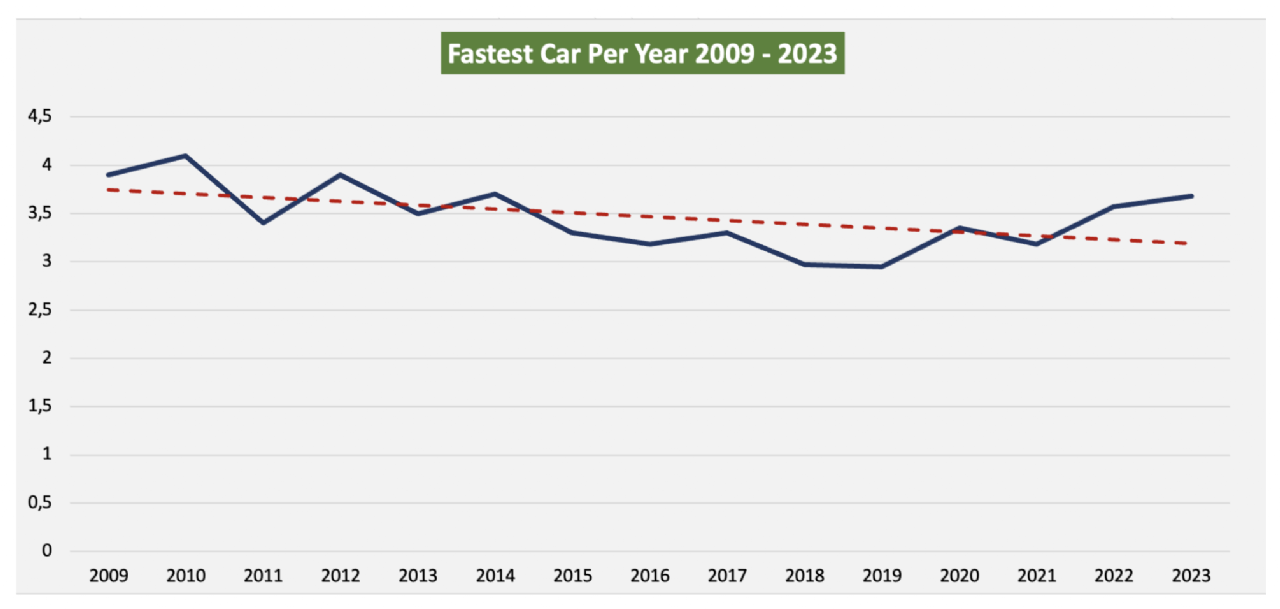
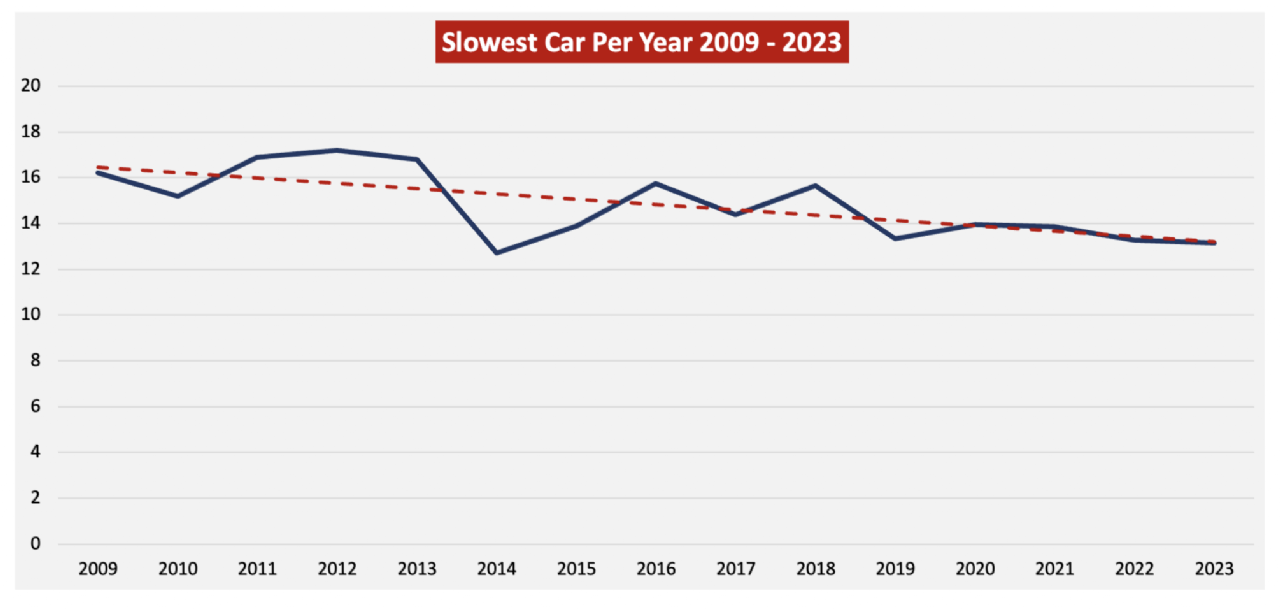
The Fastest & Slowest All Got Faster
Looking at Auto’s Top 10 Fastest & Slowest 0-100 km/h runs year-by-year it is clear that both the fastest and slowest tests of each year trend faster. The quickest time has improved by almost a second from the late three second bracket, to the late twos. Or an almost a 25% improvement. Our slowest vehicle tested every year has also improved, by almost three seconds for an 18% gain in fifteen years.
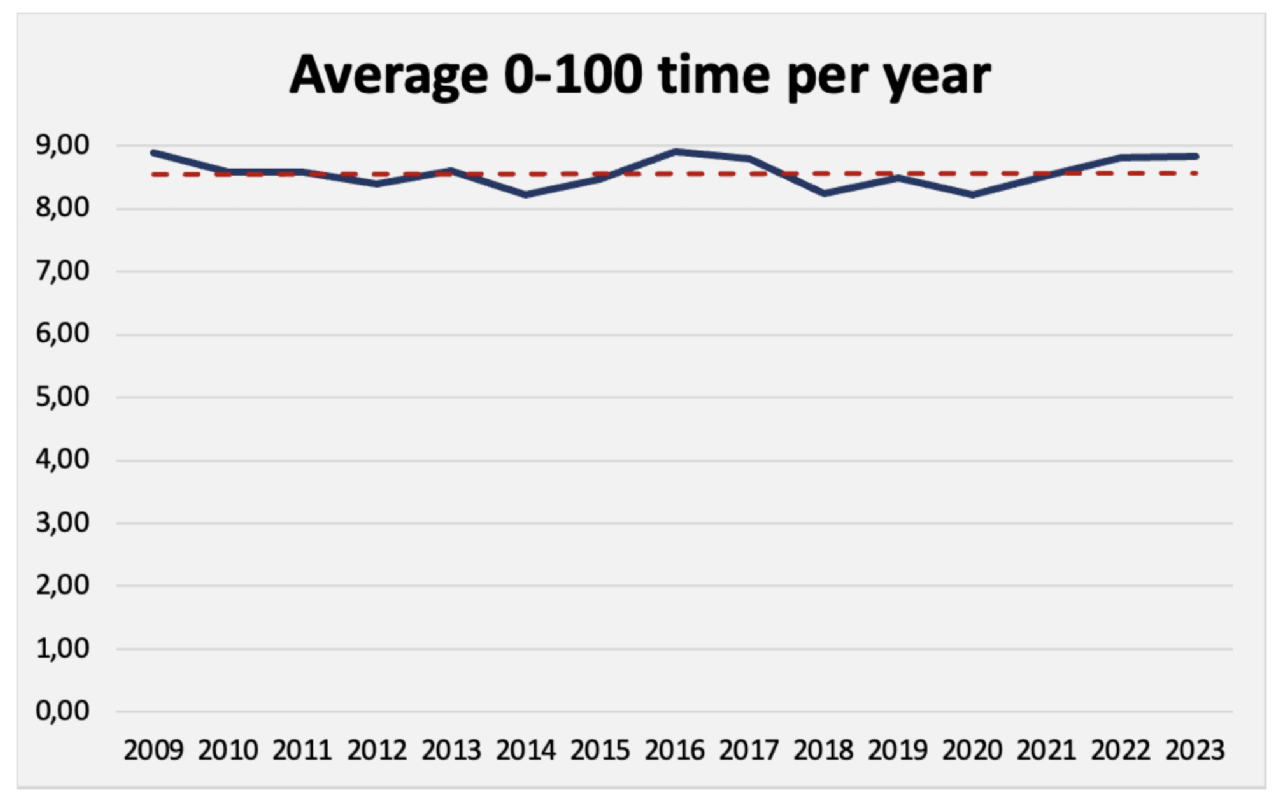
Average data: We’re Going Nowhere!
However, while the two poles of our fastest and slowest testing times have improved, we were somewhat surprised by our annual average 0-100 km/h times per year, and for good reason too. While we expected the average to improve with the quickest and slowest runs every year, the mean time was instead flat, and within a very narrow band through the fifteen year period. Not at all what we expected.
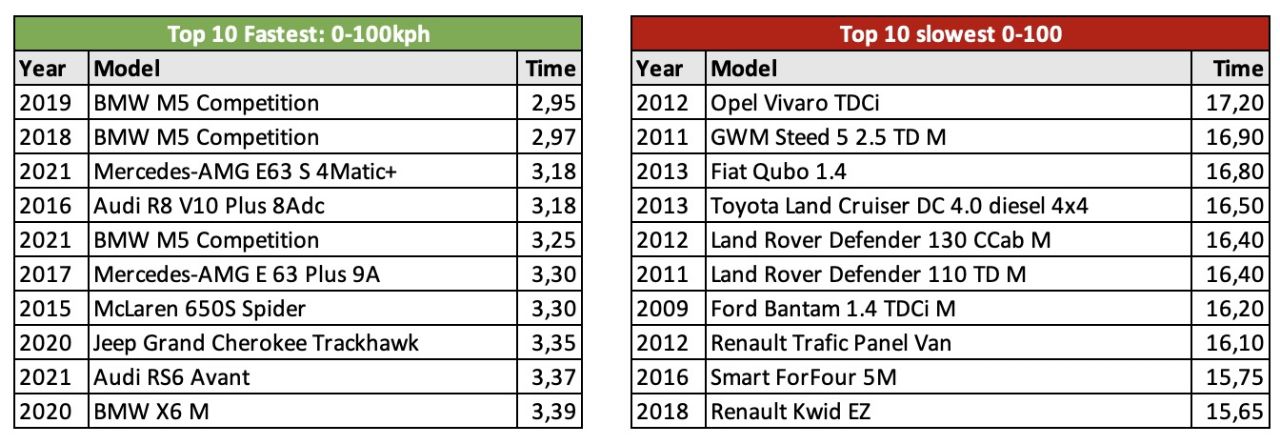
And the Quickest of All to 100 km/h is…
Digging further into the quickest and slowest data, there are also one or two surprises in our all-time tables. For example, it’s a pair of AWD sedans that were quickest to 100 km/h, with the supercars in pursuit. Our slowest tests all-time proved a little more haphazard, with a selection of panel vans and bakkies blended in with cheap hatchbacks and old school 4x4s.
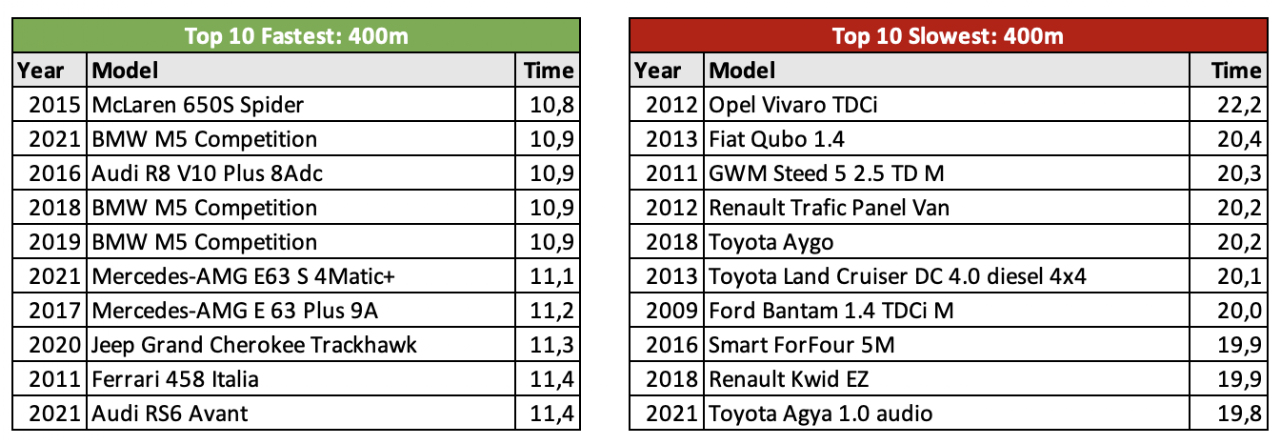
400 metre data Paints a Different Picture
The picture changes when it comes to the standing 400 m, or near as dammit to the standing quarter mile. The supercars reclaim their hallowed ground on the quarter, which also tends to favour cars that struggle a little more with traction. But more of that anon. The slowest cars over the standing quarter mile also change considerably over the 0-100 km/h bottom ten. We put that down to the smaller cars running out of gears on a longer run…
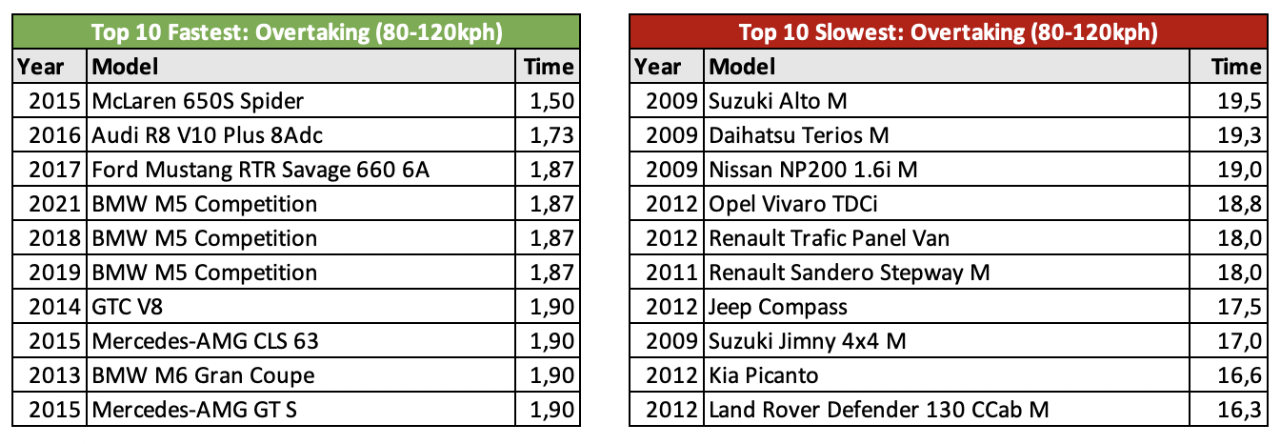
Overtaking Kings Struggle for Traction
Perhaps even more intriguing, the quickest overtaking accelerating cars over the past decade and a half are a considerably different bunch to the off the line sprinters. Evidence and then some of traction and launch difficulties on the top side, and a certain lack of torque on the bottom, perhaps?
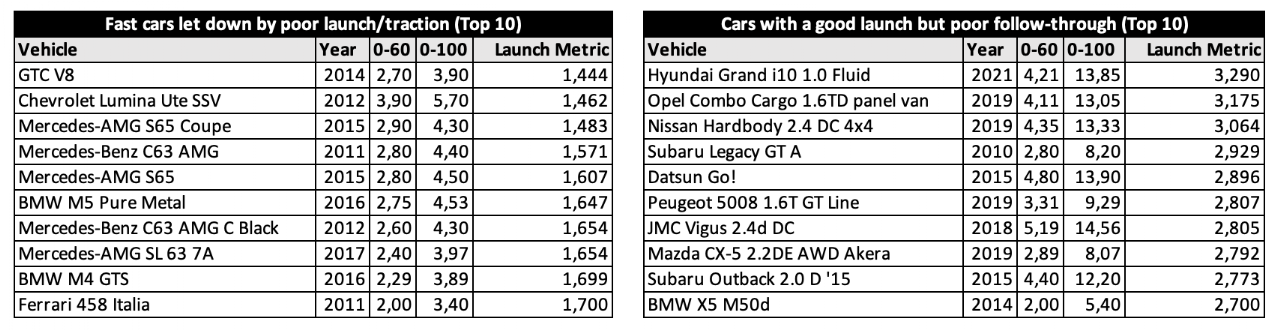
And the Real Traction Winners and Losers Are…
Lastly, and perhaps most interesting, our data guru factored a Launch Metrics ratio between all cars tested to 60 km/h versus the same cars’ 0-100 km/h times, rating them by the difference between those two times and this proves something of an eye opener. In other words, these are the cars let down most by a poor launch in the left column, or conversely, those that launch well, but simply fail to follow through.
Not surprisingly, the right Traction Metrics column is topped by a race car built for rolling starts, and the rest of them are rear driven. And simply cannot get off the line in a hurry. The cars in the right column are meanwhile a combination between those that struggle to pull a sandwich off a table, or all-wheel drive machines that rocket off the line, but fail to maintain that pace!
Of course the main table on our Test Records page also makes for some great reading and analysis, but the underlying data has also proven more than interesting. Now let’s see how the next decade and a half goes. And where South African motoring will be in 15 years’ time! - The Auto Team’